


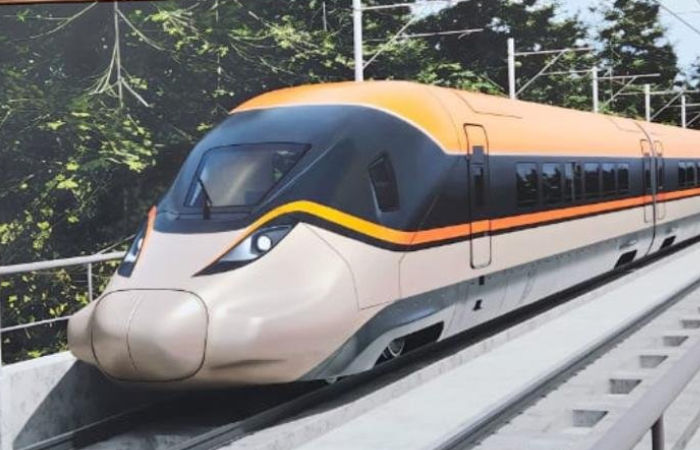
The Railway Ministry has displayed the picture of India’s first proposed bullet train at its Delhi headquarters as work on the Mumbai-Ahmedabad High Speed Rail corridor gathers pace.
The picture of India’s first proposed bullet train has been displayed at Gate Number 4 of the Ministry of Railways in Delhi, marking another symbolic milestone for the ambitious Mumbai Ahmedabad High Speed Rail project.
The high-speed train will operate on the 508-kilometre Mumbai-Ahmedabad corridor, which is being developed with technical and financial support from Japan. Designed to run at speeds of up to 320 kilometres per hour, the project aims to transform rail travel between Maharashtra and Gujarat by drastically reducing travel time.With limited halts at Surat, Vadodara and Ahmedabad, passengers are expected to complete the journey in around 2 hours and 7 minutes, making it significantly faster than current rail or road options.The Railway Ministry had earlier confirmed in February 2026 that all 1,389.5 hectares of land required for the project had been acquired and statutory approvals secured.
Construction work has since gathered momentum across multiple sections of the corridor. Out of the planned 12 stations, foundation work has already been completed at eight stations including Vapi, Bilimora, Surat, Bharuch, Anand, Vadodara, Ahmedabad and Sabarmati.
In Maharashtra, work continues at Thane, Virar and Boisar, while excavation work at the underground BKC station is nearing completion.The project has also achieved several key engineering milestones. Authorities said 17 river bridges have already been completed, while work on major bridges across the Narmada, Mahi, Tapti and Sabarmati rivers is progressing rapidly.
Depot construction at Thane, Surat and Sabarmati is also underway.
One of the most challenging parts of the project remains the 21 kilometre undersea tunnel stretch in Maharashtra. Officials stated that construction has already started and around 4.8 kilometres of tunnelling between Ghansoli and Shilphata has been completed so far.
Indian Railways believes the corridor will not only improve passenger travel but also strengthen connectivity to major industrial hubs and the upcoming Vadhvan Port through Boisar.