


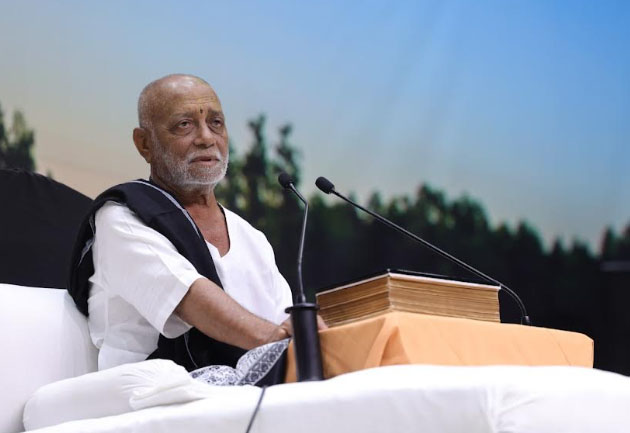
Renowned spiritual leader Morari Bapu is currently conducting a Ram Katha (discourses on the Ramayana) at the Katowice International Conference Centre, offering a solemn tribute to the
victims of Auschwitz and all those who lost their lives in Poland during times of atrocity. This ongoing Katha, titled “Manas Vairagya,” reflects timeless spiritual values of detachment, compassion, truth, and love, connecting the wisdom of the Ramayana with universal human experience. The Katha emphasizes vairagya (detachment and dispassion), symbolized byHanuman Ji, while truth, love, and compassion are represented by Ram, Krishna, and Shiva, respectively. Drawing upon key verses, Bapu has picked two central lines: Bal Kand 216 and Aranya Kand 15 : “Sahaj bairag roop manu mora, thakita hota jimi chanda chakora” “Kahia tata so parama bairagi, tran sama siddhi tini guna tyagi.” (“My nature is of spontaneous detachment; just as the moon always draws the chakora bird without effort, so too does my heart remain naturally inclined toward renunciation. It is said that he is the supreme renunciate who has mastered the threefold perfection and renounced the threefold qualities of worldly existence.) These verses convey the essence of simplicity, moral integrity, and inner
discipline. He noted that the Ayodhya Kand exemplifies vairagya most profoundly, and he shared key ethical teachings from the Ramayana: that theft is a sin, but so is the unnecessary accumulation of wealth. He further explained that speech
(Shabd) is Brahma, while silence (Ashabd) is Parabrahma, illustrating the balance between expression and inner stillness.
Addressing questions on fear of death, Bapu observed, “Fear itself is death.”