


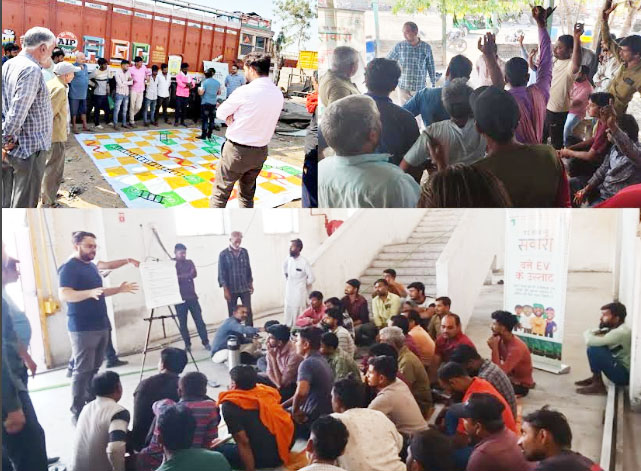
“If electric vehicles—whether bikes, cars or even trucks—are adopted by the next generation, it will be a very good step towards reducing pollution in the future. Even operationally, trucks have a much higher horsepower since they run on motors,” says Parth Rawal, an automobile parts dealer from Ahmedabad. He remains confident that his own business will not get adversely impacted by the emergence of green mobility options. As he says, “I deal in auto parts, and electric vehicles don’t have engines, but this will not create any major issues for my business. There will definitely be some new components, and as we gain knowledge about these parts, the business will adapt accordingly.” For Kuldeep, Parth and many attendees in Ahmedabad, the informal ‘Chai Pe Charcha’ conversations, informative ‘Snakes and Ladders’ games and the YouTube channel, “EV OK Please” by Nayi Soch Ki Sawaari are building bridges between the experts and the community.Parth gained these insights at a new pan-Indian awareness initiative called Nayi Soch Ki Sawaari (NSKS) steered by the Centre of Excellence for Zero Emission Trucking (CoEZET), IIT Madras. NSKS brought together Parth and over 142 other grassroots stakeholders including drivers, mechanics, and fleet operators in Ahmedabad to help shape a more inclusive transport future and discuss how electric trucks can potentially play a crucial role in India’s journey towards sustainability. Similar events have been organised in Vadodara, Surat, Rajkot and Bhavnagar and more events continue to be organised across India under the NSKS initiative.Kuldeep Singh, a local driver and attendee, summed up the sentiment: “Some of the information that was shared about e-trucks was truly eye-opening, like how much more efficient and comfortable they could be to drive. Of course, there are concerns about charging points, but I believe once these trucks start hitting the roads, charging stations will follow. It might be difficult at first, but we will adapt, and I’m positive about that.”