


Narco-Terror Will Be Eliminated Through ‘Detect, Disrupt and Destroy’: Home Minister Unveils Three-Year Roadmap
When it comes to decisive leadership on complex and critical issues concerning India’s internal security, Union Home Minister Amit Shah stands out prominently. A clear strategy, time-bound planning, and result-oriented execution have become the hallmarks of his leadership. After steering several major national security initiatives to decisive outcomes, his next mission is to free India from the entire ecosystem of drugs and narco-terror.
To achieve this objective, the Home Minister has laid out a comprehensive three-year roadmap aimed not merely at increasing drug seizures, but at dismantling the entire network from production and trafficking to financing and distribution.
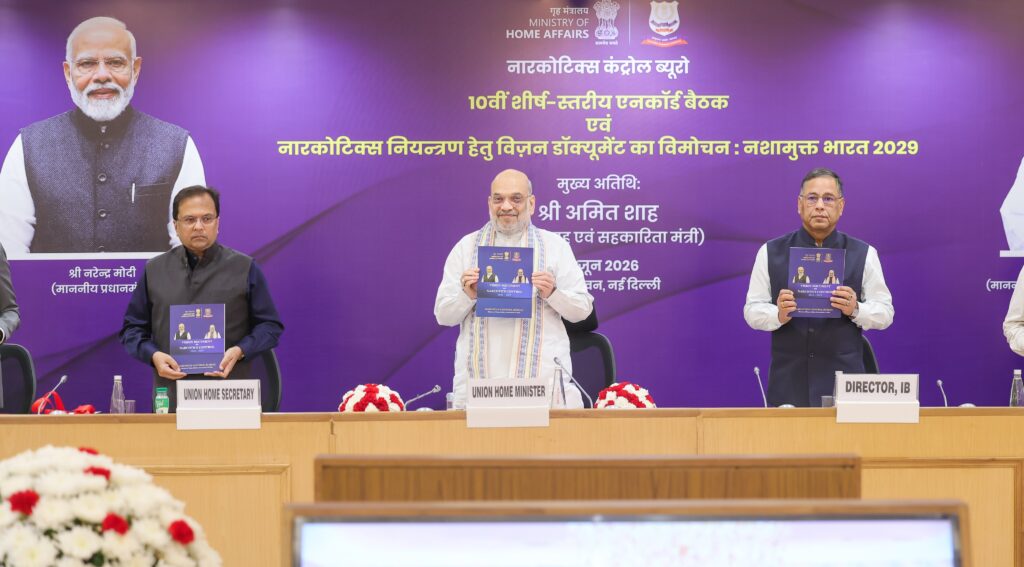
With this vision, the 10th Apex-Level Meeting of the Narco-Coordination Centre (NCORD) was convened in New Delhi under the chairmanship of Union Home Minister Amit Shah. During the meeting, the Vision Document on Drug Control (2026–2029) was released, the Narcotics Control Bureau (NCB) Annual Report was presented, and an online Drug Disposal Fortnight Campaign was launched to destroy 209,500 kilograms of seized narcotic substances worth approximately ₹6,000 crore. Far from being a routine government event, the meeting marked a significant step toward achieving the vision of a “Drug-Free India” through a structured, time-bound strategy backed by concrete action.
In line with Prime Minister Narendra Modi’s vision of a Nasha Mukt Bharat (Drug-Free India), Amit Shah has formulated a clear, multi-layered strategy founded on the principle of “Detect, Disrupt and Destroy.” The approach begins with accurately identifying drug networks, followed by disrupting their supply chains, financial infrastructure, and operational mechanisms, and ultimately dismantling the entire ecosystem in a manner that prevents its resurgence. This framework will serve as the cornerstone of India’s national anti-drug strategy over the next three years.
Under Amit Shah’s leadership, India’s campaign against narcotics has gained unprecedented momentum in recent years. Guided by a policy of zero tolerance and a network-centric enforcement approach, the country has, since the Modi government assumed office in 2014, seized narcotic substances valued at approximately ₹1.84 lakh crore, destroyed drugs worth nearly ₹90,000 crore, recovered millions of kilograms of narcotics, and carried out record action against illegal opium cultivation. These figures reflect not only the effectiveness of law enforcement but also Amit Shah’s results-driven strategy and firm resolve to eradicate the narco ecosystem at its roots.
A defining characteristic of Amit Shah’s leadership has been his commitment to translating ambitious objectives into measurable outcomes. His approach consistently combines clear goals, time-bound execution, and rigorous implementation to address some of India’s most challenging national security issues. Landmark decisions such as the abrogation of Article 370, decisive action against Left-Wing Extremism, and several initiatives aimed at strengthening India’s internal security exemplify this governance model. These measures have significantly addressed challenges that had persisted for decades.
Now, with the same determination, Amit Shah has placed the vision of a Drug-Free India at the forefront of the national agenda. The three-year roadmap is not confined to curbing drug trafficking alone; it seeks to dismantle the entire narco-terror ecosystem from its foundations. If implemented according to the prescribed timeline, the strategy has the potential to mark India’s most comprehensive and decisive success yet in its fight against drugs and narco-terror.